What concrete parameters allow us to measure the quality of an infant’s awakening during their first year? Between institutional recommendations, parental practices, and recent data on the effects of screens, the benchmarks vary according to the sources. This article confronts the available data to identify what truly impacts the well-being and development of the baby.
Screens before one year: what the data shows about baby’s awakening
Most competitors focus on lists of activities by age group. A rarely addressed angle: the measurable impact of passive screen time on early sensory and motor acquisitions.
The World Health Organization, in its 2019 guidelines on physical activity, sedentary behavior, and sleep for children under five, recommends no passive screen time before the age of one. The recommendation emphasizes floor play, direct interactions, songs, and reading.
The main issue is not the screen as an object, but what it replaces during the day. According to a publication in Frontiers in Sociology in September 2026, the substitution effect of screens on face-to-face interactions and motor play is the most documented factor. Recent recommendations emphasize less on a maximum duration and more on what the screen concretely displaces: eye contact with adults, free movement, sleep.
Families looking for suitable alternatives for the early months can find on Bébé Bonheur! a selection of awakening toys designed to replace these passive moments with direct sensory interactions.
| Activity | WHO Recommendation (under one year) | Main effect on development |
|---|---|---|
| Passive screen (TV, tablet without interaction) | Not recommended | Substitution of direct interactions and motor play |
| Free floor play | Encouraged several times a day | Motor coordination, sensory exploration |
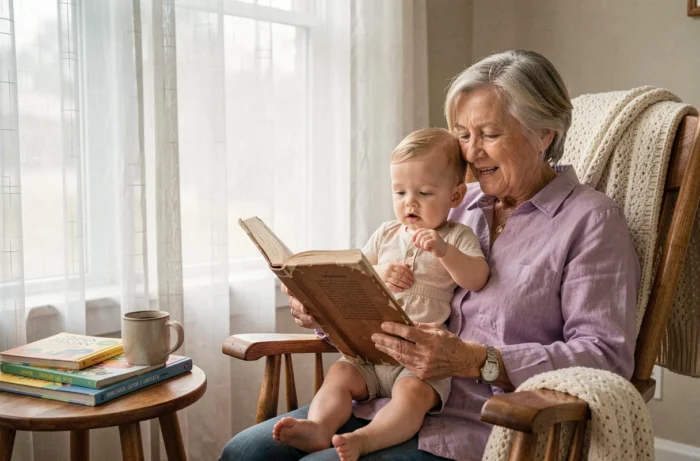
| Shared reading with an adult | Encouraged daily | Language development, emotional bond |
| Songs and vocal exchanges | Encouraged throughout the day | Sound recognition, early communication |
Active presence of the adult and sensory development of the infant
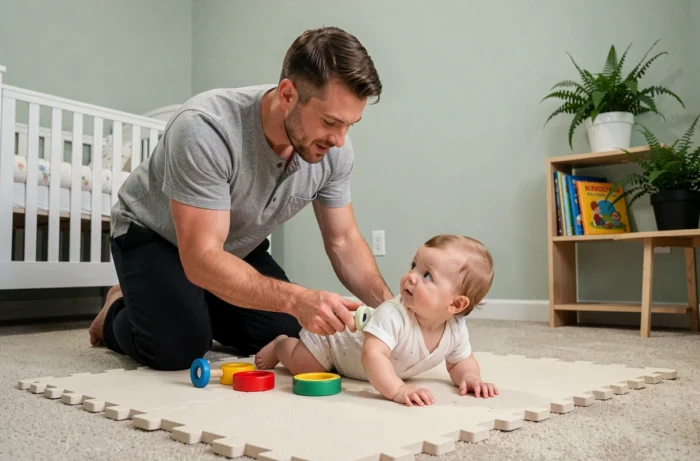
One data point consistently emerges in recent publications: the quality of parental presence outweighs the quantity of toys or activities offered. The publication in Frontiers in Sociology clearly distinguishes between passive presence (screen on in the room, adult on their phone) and active presence (commenting on what the baby is watching, asking questions, relating objects to daily life).
This distinction has direct practical implications. A parent who verbally describes what they are doing while preparing a meal provides their child with richer language stimulation than a musical mobile left on. Face-to-face interaction remains the most documented vector of awakening for the first three months.
What active presence concretely changes
- Commenting on daily gestures (dressing, meals, bath) exposes the baby to contextualized vocabulary, directly linked to sensations they experience in real-time.
- Responding to the infant’s vocalizations, even non-verbal ones, reinforces the conversational exchange pattern that structures language acquisition.
- Offering objects with varied textures while naming them allows for coupling tactile and auditory stimulation, two sensory channels active from the first weeks.
Conversely, an environment saturated with simultaneous stimuli (music, light, movement) can produce the opposite effect. Sensory overload, documented by several specialized sources, manifests as crying, averted gaze, or sudden sleep. Reducing the number of stimuli to increase quality remains a more reliable principle than multiplying activities.
Free motor skills and coordination: prioritizing the floor over equipment
Competitors often mention play mats or bouncers as supports for motor development. The available data suggests a different approach.
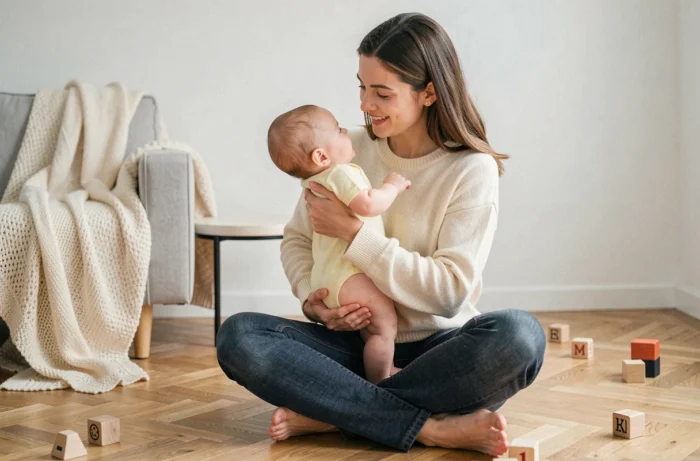
The WHO recommends limiting the time spent strapped into a seat, stroller, or bouncer. Free floor play, on the back then on the stomach, forms the basis for developing motor coordination. A flat, clear floor remains the most effective awakening equipment for an infant.
Why the floor promotes coordination
A baby placed on their back on a firm surface has the full range of movement necessary to explore their hands, turn their head, and pedal with their legs. These seemingly simple gestures build the neurological connections that will later allow rolling over, sitting up, and then walking.
Time spent on the stomach, offered in short periods under supervision, strengthens neck and back muscles. It also prepares hand-eye coordination as the baby begins to push against the floor to lift their head and observe their surroundings.
Age-appropriate awakening toys: concrete selection criteria
The market for infant toys is vast. A few criteria help filter what truly serves sensory development and coordination.
- For the first months, objects with high visual contrast (black and white) engage a still limited field of vision without causing overload.
- Light rattles, easy to grasp, accompany the gradual development of voluntary grasping.
- Fabric or thick cardboard books, manipulable without risk, combine tactile exploration and the first moments of shared reading.
- Objects producing a soft sound when touched (integrated rattle, crinkly paper) encourage the link between action and consequence, a fundamental learning of coordination.
An appropriate toy responds to a single sensory channel at a time rather than combining light, sound, and movement. This simplicity allows the infant to process information without saturation.
The WHO recommendations remind us that floor play, vocal exchanges, and shared reading cover most of the infant’s awakening needs. Parents’ choices focus less on accumulating activities and more on the regularity and quality of direct interaction moments with their child.