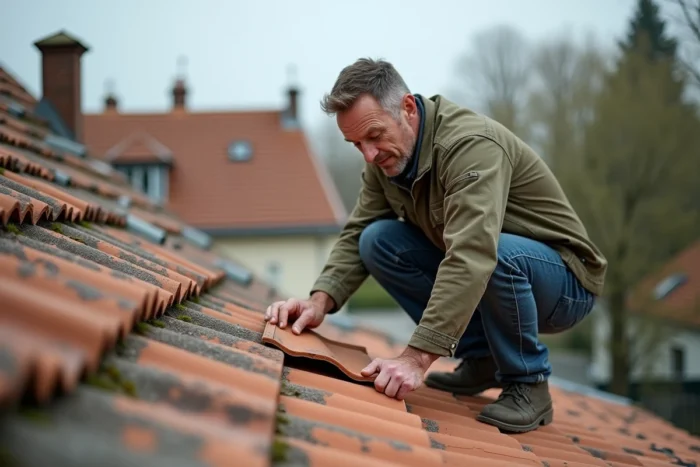
You noticed dark spots on your roof after a rain shower, or a greenish moss that keeps returning despite cleanings? These signs often point to the same problem: porous tiles. The porosity of a roofing tile is not always visible to the naked eye, but it directly threatens the waterproofing of your home. Understanding this phenomenon allows you to intervene before infiltrations settle in.
The absorption test: check the porosity of a tile in just a few minutes
Before climbing onto the roof or calling a roofer, there is a simple action to assess the condition of a tile. Remove an accessible tile (at the edge or near a vent) and pour a stream of water on its outer face.
A healthy tile allows water to run off its surface. The water forms droplets and glides without penetrating. In contrast, a porous tile absorbs water within seconds: the surface darkens immediately and the water seems to disappear into the material.
Also, turn the tile over. If you see a whitish deposit on the inner face, it is limestone deposited by water that has passed through the terracotta. This white deposit confirms that water is migrating through the thickness of the material. A roofer on a construction forum describes this phenomenon exactly: tiles that appear dry but are covered with white marks on the attic side.
To find out how to reliably identify a porous tile, this absorption test remains the most direct method, much more telling than a simple visual inspection from the ground.
Visible signs from the ground: what your roof is telling you
You don’t always have the option to remove a tile. Some signals can be spotted without climbing onto the roof.
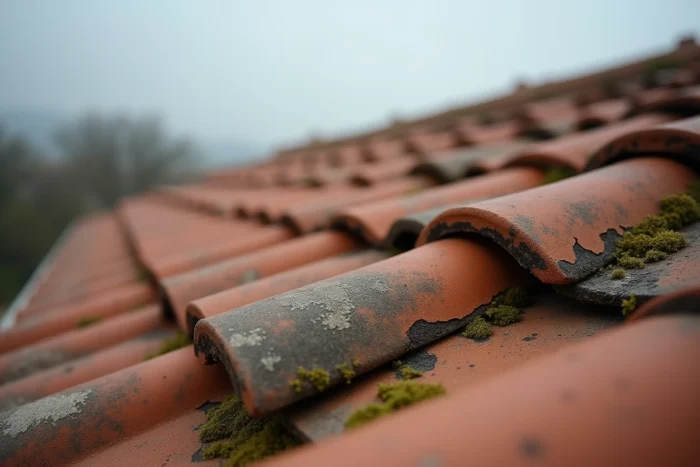
Color change after rain
Observe your roof just after a rain shower, then a few hours later. Tiles that remain dark long after the rain retain water in their pores. Neighboring tiles, if they dry faster, serve as an immediate point of comparison.
Persistent moss and lichens
Moss clings everywhere, including on healthy tiles. The difference lies in the speed of recolonization. On a porous tile, microorganisms find a permanently moist environment. Moss returns a few months after a moss removal on the most porous areas, while it takes several years to re-establish on a waterproof tile.
Micro-cracks and chips
The absorbed water freezes in winter. As it expands, it causes the terracotta to crack from the inside. This mechanism is called freeze-thaw. The tiles then show fine cracks, scales, or broken corners. If you spot tile fragments in your gutters in spring, the freeze-thaw process has already done its work.
Hollow sound when tapped
Tap a suspicious tile with the back of your hand. A dense and healthy tile produces a clear, almost metallic sound. A porous or weakened tile sounds hollow, like a cracked pot. This acoustic test complements visual observation effectively.
Cleaning pressure and aggressive products: the trap that worsens porosity
Many homeowners think they are doing the right thing by cleaning their roof with a pressure washer. The result can be the opposite of the desired effect.
A jet that is too powerful directed at close range “sabre” the surface of the tile. It tears away the compact outer layer and opens the pores. The tile then becomes more absorbent than before cleaning. Exterior cleaning professionals now recommend strictly adjusting the pressure according to the type of material and its condition.
Bleach and strong acids also degrade the structure of the terracotta. The recommended alternatives are gentler: hot water, baking soda, black soap. These products clean without altering the material.
The protocol that yields the best results on already porous tiles follows a precise order:
- Moderate high-pressure cleaning, maintaining a sufficient distance and working in the direction of water flow, never against the joints
- Application of a fungicidal treatment in saturation, at low pressure, so that the product penetrates the pores and neutralizes microorganisms deeply
- Maintaining a temperature range between 10 and 25 °C during application, to ensure the effectiveness of the treatment and avoid too rapid drying

Water-repellent treatment or replacement: choosing the right solution for your roof
Once porosity is confirmed, two paths open up. The choice depends on the degree of advancement of the problem.
When water-repellent treatment is sufficient
If the tiles absorb water but remain structurally intact (no cracks, no chips), a water-repellent treatment can significantly extend their lifespan. The product forms an invisible film that prevents water from penetrating while allowing water vapor to escape. The water-repellent treatment protects without altering the appearance or blocking the material’s breathability.
This treatment only makes sense after appropriate cleaning and complete removal of moss and lichens. Applied to a dirty surface, it seals dirt and spores inside.
When replacement is necessary
Cracked, chipped, or crumbling tiles cannot be saved by a surface treatment. The freeze has already fragmented the internal structure. In this case, partial or total replacement of the roof remains the only reliable option.
Before approving a water-repellent treatment quote, check these points:
- Presence or absence of visible cracks on the affected tiles
- Age of the roof covering and maintenance history (a roof that has never been maintained for several decades often accumulates both porosity and structural problems)
- Condition of the underlying framework and insulation, as old infiltrations may have caused invisible damage from the outside
- Nature of the proposed quote: a serious professional inspects before estimating and does not propose a water-repellent treatment on already frost-sensitive tiles
The porosity of tiles evolves slowly, often over several years. Getting into the habit of observing your roof after each rain episode remains the most effective reflex. A tile that dries poorly today will be a cracked tile next winter.