
Trimming a hedge is not just about moving a device back and forth over the vegetation. The result primarily depends on the cutting geometry adopted, the direction in which the blade attacks the foliage, and the timing chosen based on the species. These often overlooked parameters make the difference between a hedge that thickens year after year and one that browns or becomes bare at the base.
Trapezoidal profile: the geometry that prevents thinning
Most hedges trimmed in a strict rectangle eventually lose their foliage at the lower part. The reason is simple: the top, as wide as the base, casts shade on the lower branches. Deprived of light, they stop producing leaves.
The technical solution is called the trapezoidal profile. The principle is to trim the hedge so that the top is narrower than the base. This way, the entire face receives sunlight, stimulating branching throughout the height.
To achieve this profile, the blade of the hedge trimmer is slightly tilted inward while moving upward. The angle does not need to be pronounced: a few centimeters of difference between the bottom and the top is sufficient.
On a hedge of thujas or privets that is already partially bare at the bottom, a gradual recutting combined with this profile often helps to revive the vegetation, provided that the wood is not completely dead. The resources available on sculpte-haie.com detail the choice of device suitable for this type of intervention.
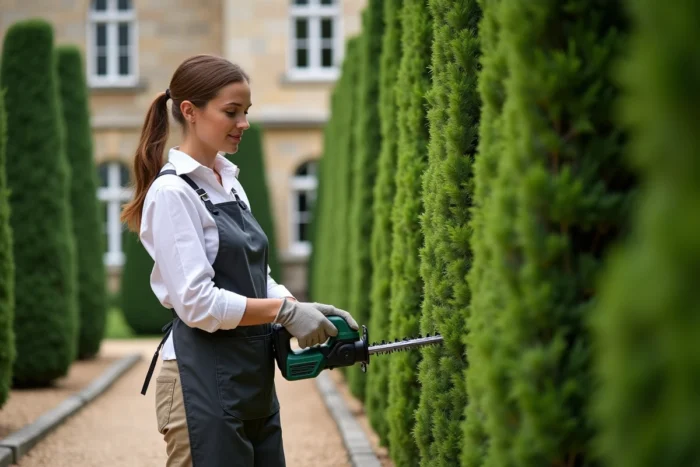
Cutting direction and blade movement on a shrub hedge
A common reflex is to start from the top of the hedge and go down. This gesture projects the cut waste onto the lower branches, which then become trapped in the foliage and promote fungal diseases.
The cutting is always done from bottom to top, sweeping the side face in an upward motion. The residues then fall to the ground instead of accumulating in the hedge. For the top, work horizontally while moving along the hedge, with the blade slightly tilted to let the clippings fall to the side.
String line and templates for a straight line
Achieving a straight top by eye is a gamble. The most reliable method is to plant two stakes at each end of the hedge and stretch a string line at the desired height. This visual marker guides the cut without having to constantly step back to check the alignment.
For hedges sculpted into geometric shapes or topiary, templates made of wire or rigid mesh serve as a guide. They are placed against the hedge, and everything that exceeds is cut. This technique is used by landscapers to produce regular volumes (balls, cones, crenellations) without improvisation.
Sharpening and condition of the blade: the step that changes the cut
A dull blade does not cut branches; it crushes them. Torn plant tissues brown within a few days and become entry points for pathogenic fungi. A sharp blade produces a clean cut that heals quickly.
Sharpening should be checked before each trimming session. On an electric or battery-operated hedge trimmer, a flat file is run over each tooth while respecting the original angle. The blade must also be clean: dried sap creates a sticky film that hinders movement and increases mechanical effort. A cloth soaked in pine resin or alcohol is sufficient to clean the blades after use.
Elements to check before each trimming:
- The condition of the edge, by running a thumb perpendicularly to the blade (without pressing) to feel the sharpness
- The absence of play between the two blades, which would cause uneven shearing and vibrations
- The lubrication of the blades with suitable oil, to reduce heating during prolonged cuts
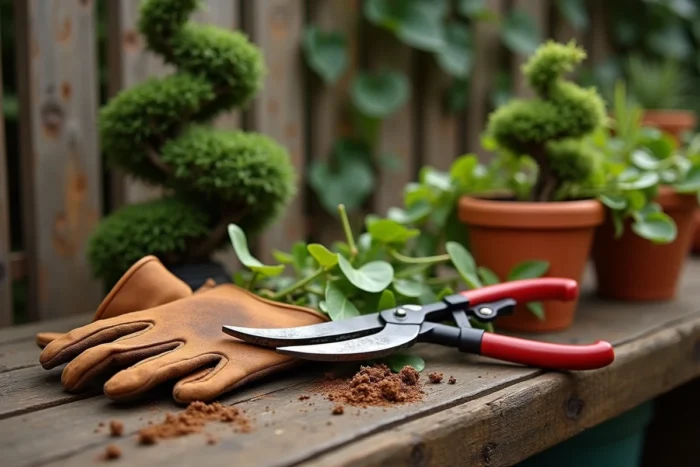
Trimming schedule according to hedge type and wildlife protection
The choice of trimming period directly depends on the species. Evergreen hedges (laurel, thuja, cypress) are preferably trimmed in late spring, after the first growth, and possibly a second time in late summer. Flowering hedges are trimmed just after flowering to avoid removing the buds for the next season. Wild hedges are ideally trimmed in late summer or early autumn.
Beyond the horticultural calendar, the Environmental Code regulates interventions during the bird nesting period. Severe trimming in the heart of spring and summer should be avoided to prevent destroying nests or disrupting reproduction. This legal constraint is often unknown to individuals, but local authorities and state services regularly remind it.
Trimming frequency and regular maintenance
Fast-growing hedges (privet, hornbeam, palm laurel) require two to three passes per year to remain dense. Slow-growing species (yew, boxwood) only need one annual trim.
Some guidelines for adjusting the frequency:
- Fast-growing evergreen hedge: main trim in spring, touch-up in September
- Cypress hedge (thuja, Leyland cypress): two trims per year, never on old wood that does not regrow
- Free or wild hedge: one formative trim per year, respecting the natural shape of the shrubs
Gentle trimming and gradual recutting: the landscapers’ approach
Gentle trimming involves reducing vegetation in stages rather than cutting it back severely all at once. On an aged or unbalanced hedge, a brutal recutting stresses the shrub and can cause permanent dead zones, especially on conifers.
The gradual approach spreads the effort over two or three years. In the first year, one side of the hedge is reduced. The following season, the other side is addressed once the first has regrown. The top is lowered last. This protocol leaves the plant with enough leaf area to continue photosynthesizing and producing new shoots.
This method requires patience, but it avoids the classic scenario of a thuja cut too short that exposes brown wood for years. On wild hedges composed of several species, gentle trimming also preserves the diversity of flowering and the ecological interest of the hedge for pollinators and nesting birds.
The choice of technique, cutting profile, and schedule forms a coherent whole. A well-maintained hedge gains density with each trim instead of becoming hollow. Regular maintenance of the blade and respect for nesting periods complement this approach for a sustainable result, season after season.