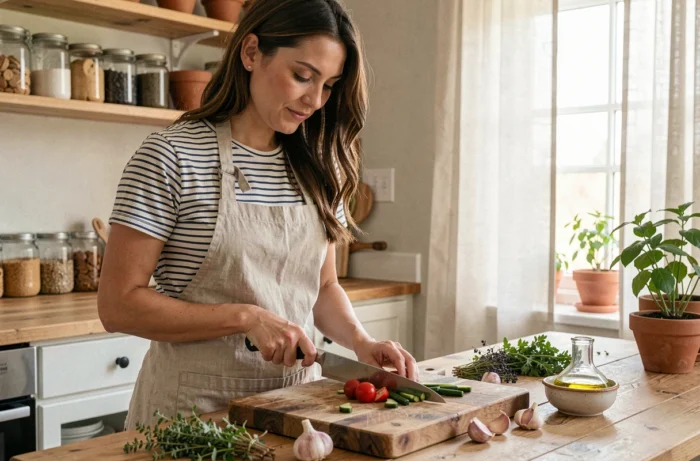
Home cooking refers to the preparation of meals using raw or minimally processed ingredients, without resorting to ready-to-eat industrial dishes. In France, meal preparation averages 53 minutes per day according to INSEE. This time, often perceived as non-negotiable, can be significantly reduced with a few concrete adjustments in organization, food choices, and cooking methods.
Batch cooking and group preparation: the most time-efficient lever
Batch cooking involves concentrating the preparation of several meals into a single time slot, usually on the weekend. In two to three hours, the basics for the week are ready: chopped vegetables, cooked grains, portioned sauces. For the rest of the week, you just need to assemble and reheat, bringing daily kitchen time down to about ten minutes.
What distinguishes this method from simple meal planning is the component logic. You don’t prepare five finished dishes: you cook a batch of rice, a batch of lentils, a tray of roasted vegetables, and combine them differently each night. This avoids monotony while limiting waste.
For those who appreciate this approach but lack experience, I love cooking with Myn Idee on Cookinette details concrete tips for structuring group preparation sessions.
Batch cooking has even become professionalized: service providers come to your home to prepare all the meals for the week in a single session. This service falls under personal services, which entitles you to a 50% tax credit on the cost of the service. The household retains control over ingredient choices and storage while delegating execution.
Utensils and cooking: simplifying equipment for frictionless home cooking
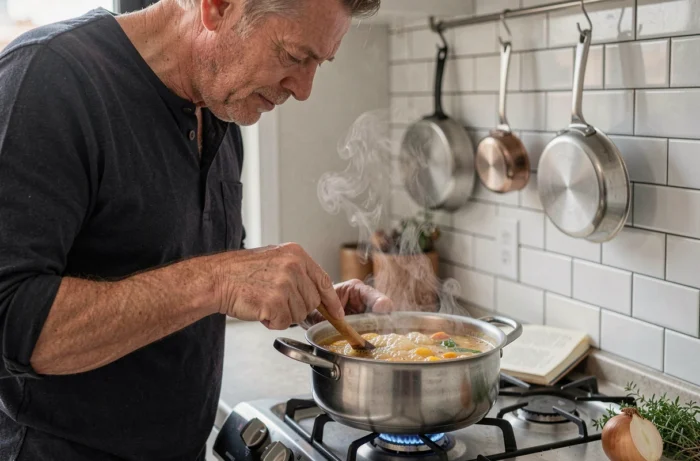
One of the most underestimated barriers to daily cooking is the perceived complexity of equipment. Three versatile utensils are sufficient to cover most preparations: a large skillet, a Dutch oven, and a baking sheet. A good chef’s knife effectively replaces an entire drawer of gadgets.
Reducing the number of utensils also speeds up cleaning, which constitutes a significant portion of the time spent in the kitchen. Less dishware means less resistance to getting started.
Preferred cooking methods for daily use
- Oven cooking on a single tray: vegetables, proteins, and starches cook together, unattended, in 20 to 35 minutes depending on the food
- Steaming, which preserves the nutrients in vegetables and requires no added fat
- Passive cooking of pasta, which involves turning off the heat after a few minutes of boiling and letting the pasta finish cooking with the lid on, reducing energy consumption
Consistently covering pots while heating is a simple gesture that reduces cooking time and energy expenditure. Turning off the oven a few minutes before the cooking is finished takes advantage of residual heat without compromising the result.
Choosing raw ingredients and storage to limit industrial dishes
Cooking at home more often means having the right ingredients on hand. Raw products (fresh vegetables, dried legumes, whole grains, eggs) offer a significantly lower cost per meal than prepared dishes while allowing control over the amount of added salt, sugar, and fats.
Dried legumes (lentils, chickpeas, beans) are particularly interesting: they can be stored for several months, are inexpensive, and provide plant-based proteins and fiber. A batch cooked at the beginning of the week can be used in salads, soups, or as a side dish.
Building a functional pantry
A well-stocked pantry with staple products reduces the temptation to order a ready-made dish. The essentials include:
- Olive oil and rapeseed oil (rich in omega-3) to vary fat intake
- Dried spices and herbs (cumin, paprika, herbes de Provence) that replace salt as a flavor enhancer
- Canned tomatoes, mustard, and vinegar for improvising quick sauces
- Plain frozen fruits and vegetables, which retain their nutritional qualities and eliminate peeling time
Unprepared frozen vegetables are nutritionally equivalent to fresh ones. They allow you to always have vegetables on hand without the risk of waste due to spoilage in the refrigerator.
Distribution of mental load: a decisive factor for sustainability
According to INSEE, women still spend significantly more time than men on domestic tasks, including cooking. This imbalance is one of the primary factors leading to the abandonment of home cooking on a daily basis: when the burden rests on one person, fatigue outweighs motivation.
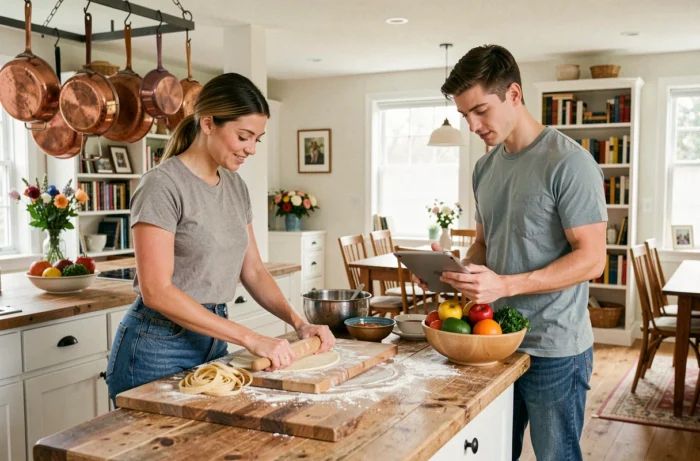
Distributing meal preparation within the household is not just a generic organizational tip. It is a structural condition. A household where two people cook lasts longer than one where only one person is responsible.
Involving children in age-appropriate tasks (washing vegetables, measuring quantities, mixing) also transforms preparation into a shared activity rather than a solitary chore. The benefit goes beyond the practical dimension: children exposed early to cooking develop familiarity with raw foods that sustainably influences their eating habits.
Cooking at home daily relies less on mastering elaborate recipes than on a system: available ingredients, a time slot for group preparation, reduced equipment, and a clear distribution of tasks. The main barrier is not a lack of skill, but a lack of prior organization.