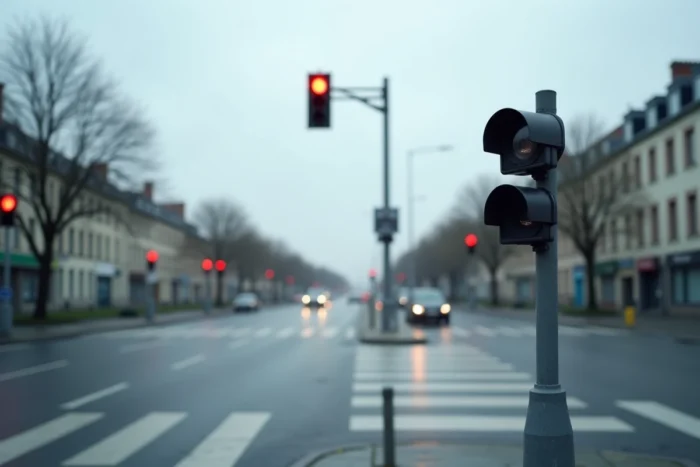
At French intersections, two types of equipment coexist on masts and gantries: traffic surveillance cameras and crossing radars. Drivers often confuse them, even though their function, technology, and legal consequences have nothing in common. Understanding what distinguishes these devices allows for a precise assessment of the risk incurred at each traffic light.
Crossing Radar and Intersection Camera: Comparative Table
The confusion lies in a physical resemblance: boxes mounted high, facing the roadway. The differences are in the triggering mechanism, the evidential value of the images, and the administrative follow-up.
| Criterion | Crossing Radar (red light) | Traffic Surveillance Camera |
|---|---|---|
| Function | Automated detection of offenses | Real-time traffic flow management |
| Triggering | Magnetic loop in the roadway, activated only at the red light | Continuous capture or triggered by motion detection |
| Images produced | Two timestamped photos of the rear of the vehicle, a few seconds apart | Video stream or untimed photos, without systematic identification |
| Legal value | Evidence usable for an automated fine (4th class offense) | No direct contravention value |
| Associated penalty | 135 euros fine and withdrawal of 4 points | No automatic sanction |
| Number in France (2025) | 842 red light radars in operation | Not publicly recorded |
To delve deeper into the difference between red light cameras and radars, the evidential logic remains the decisive criterion: only the radar produces an offense file sent to the ANTAI.
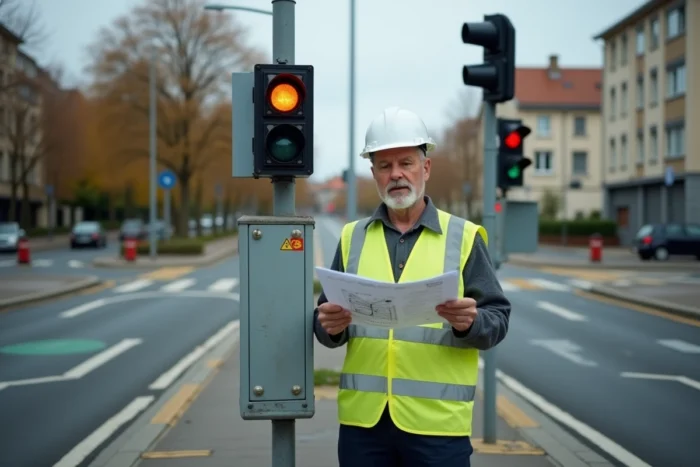
Evidential Logic of the Red Light Radar: Why Two Photos
The crossing radar does not function like a conventional camera. Its architecture relies on a magnetic loop embedded in the pavement, just after the stop line of the light. When the signal turns red, the loop activates. If a vehicle crosses it, the system triggers a first photo.
A few seconds later, a second photo is captured. These two timestamped photos prove that the vehicle continued its path after the stop line, and not that it simply stopped beyond the marking.
This two-step sequence distinguishes the radar from a surveillance camera, which films continuously without producing evidence formatted for the automated processing of fines. A traffic camera can show that a vehicle has crossed a light, but its video stream is not designed to feed into the ANTAI chain.
Case of the Orange Light: No Triggering
The device only activates when the light is already red. Passing on an orange light does not trigger the radar, even though the Highway Code generally requires stopping when the light turns orange (unless it is unsafe to stop). This clarification alleviates a common concern among drivers.
Traffic Cameras at Intersections: What Are They Really For
The cameras installed at intersections serve urban management needs, not repression. Their main role is broken down into several functions:
- Adjusting traffic light cycles in real-time according to traffic density, using vehicle detection sensors
- Feeding municipal traffic control centers with video streams to anticipate congestion
- Providing usable images post-event for law enforcement in judicial investigations (accident, hit-and-run), but only upon requisition
These cameras do not generate any automatic fines. No ticket can be issued from a traffic surveillance camera without human intervention and a separate judicial procedure. The confusion arises from the fact that these boxes sometimes resemble radars, especially when mounted on the same gantry.
Visually Recognizing a Crossing Radar
The red light radar typically appears as a rectangular box facing the rear of vehicles, installed after the stop line. It is accompanied by a specific traffic sign (radar sign) upstream of the intersection. Traffic cameras, smaller and often spherical or cylindrical, are mounted directly on the lights or lighting masts, without a warning sign.
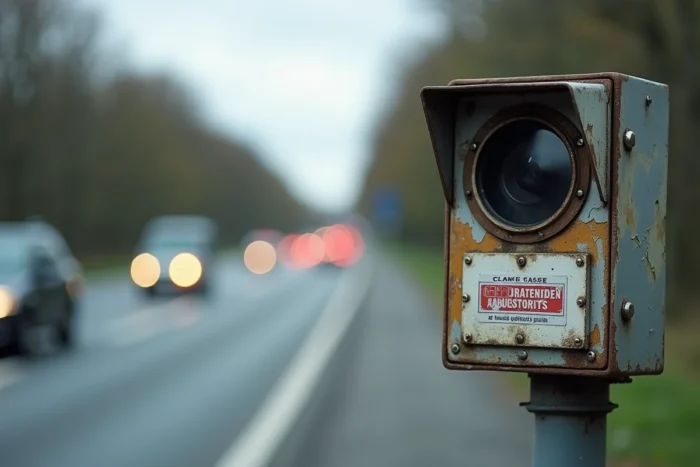
Multi-Offense Radars: Evolution of the French Automated Control Fleet
The French fleet counted 4,029 radars in total in January 2025, divided between fixed, movable, and mobile units. Red light radars represent a specific fraction of this total, but their role is evolving.
New multi-offense radars combine several detection capabilities within the same unit. Whereas a classic crossing radar is limited to checking compliance with the red light, a multi-offense radar can also measure speed, detect crossing of a continuous line, or identify phone use while driving.
This technological convergence further blurs the perceived boundary between camera and radar. A driver spotting a box at an intersection can no longer rely solely on appearance to determine what the device is monitoring. The radar sign upstream remains the only reliable indicator of the presence of an automated sanctioning device.
Crossing Radars at Level Crossings
The official category of crossing radars is not limited to red lights. It also includes level crossings, where the same principle of magnetic loop and double photo applies when the barrier is lowered. The penalties are identical: 135 euros fine and withdrawal of 4 points.
The distinction between surveillance cameras and crossing radars is based on a simple criterion: the ability to produce automated evidence of an offense. As long as a box does not combine a magnetic loop, double timestamped photo, and direct transmission to the ANTAI, it does not generate a fine. The radar sign remains, for the driver, the most reliable reference on a daily basis.