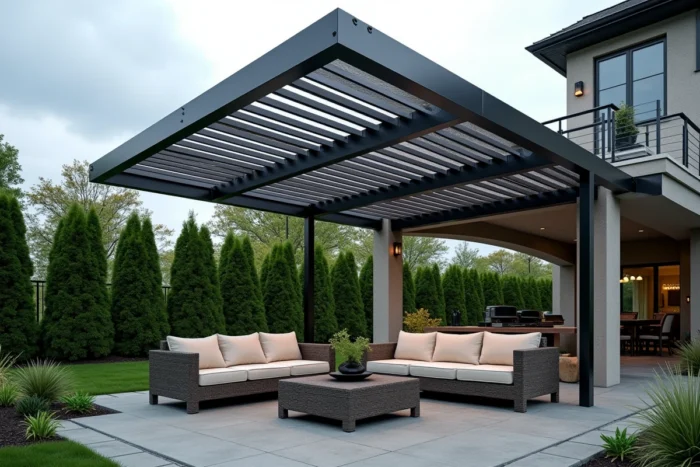
A bioclimatic pergola with adjustable slats offers remarkable comfort on a daily basis, but its behavior in strong winds remains a poorly understood subject. Many homeowners hesitate between closing the slats to “protect” the structure or opening them to let the air through. However, the choice of position has direct consequences on the overall stability, and the answer is not always intuitive.
Slat position in safety mode: what manufacturers really recommend
The most common technical guideline among manufacturers and installers is clear: in case of strong winds, the slats should be positioned vertically, opened at 90°. This position allows gusts to pass through the structure without encountering a solid surface that would act as a sail.
Leaving the slats closed flat creates a considerable wind catch. The roof then becomes a rigid plane on which pressure accumulates, putting stress on the fixings, posts, and anchors well beyond what they endure in normal use.
The question of the orientation of pergola slats against the wind does deserve an important nuance. Some manufacturers, depending on the length of the pergola and its static calculations, recommend completely closing the slats for shorter models. Field feedback varies on this point, and the right answer depends on the exact model installed at your location.
The manufacturer’s manual remains the reference. If you can no longer find it, contact your installer before the next windy episode rather than relying on generic advice.

Side screens and pergola accessories: the weak link against gusts
A point often overlooked in discussions about wind resistance: attached accessories are much more vulnerable than the main structure. Screens, side shades, zip fabrics, or windbreak curtains create solid surfaces that abruptly catch wind pressure.
Even if your aluminum pergola is designed to withstand sustained winds, a deployed side shade can be enough to destabilize the entire structure. The force exerted on a vertically stretched fabric is transmitted to the fixings and posts, with an unfavorable lever arm.
Actions to take before a forecasted windy episode:
- Fully retract the side shades and screens, even if they are advertised as resistant to moderate winds
- Remove any non-fixed movable items under the pergola (hanging lights, potted plants, lightweight furniture)
- Check that the slats are indeed in safety position and that the orientation mechanism is not blocked by debris
- Deactivate automatic mode if the wind sensor is not functioning properly
This distinction between the resistance of the structure and that of the accessories is rarely highlighted in commercial sheets. A pergola advertised as wind-resistant may very well hold up in moderate winds without its peripheral equipment keeping pace.
Automatic wind sensors: real safety but not infallible
Recent bioclimatic pergolas often integrate a wind sensor (anemometer) connected to the motorization of the slats. When the wind exceeds a predefined threshold, the system automatically tilts the slats into safety position, without human intervention.
This device significantly reduces the risk of error, especially during nighttime gusts or sudden episodes when no one is home. It is a concrete advantage over manual models, where everything relies on the owner’s vigilance.
The concrete limits of automation
A wind sensor is not a maintenance-free device. Several situations can render it inoperative:
- Clogging by leaves, pollen, or bird droppings that distort the measurement
- Motorization failure preventing the slats from pivoting despite the sensor’s signal
- Power outage during the windy episode, rendering the entire system inactive
A wind sensor does not replace a manual check before each weather alert. If your pergola is not equipped with a battery backup system, the slats will remain in their last position in case of a power cut, potentially the worst configuration against gusts.

Ground anchoring and structural resistance: the real factors that matter
The orientation of the slats is only part of the equation. A pergola’s ability to withstand strong winds primarily depends on the quality of its ground anchoring and the robustness of its aluminum structure.
A pergola backed against a load-bearing wall benefits from a solid fixation point on one side, which reduces stress on the front posts. In contrast, a freestanding pergola (isolated in the garden) relies entirely on its four posts, and the quality of the anchoring in the slab or ground becomes crucial.
Undersized anchors negate any benefit from good slat orientation. Chemical anchors in loose soil, plates simply placed on concrete blocks, or fixings corroded after a few years represent structural weaknesses that the positioning of the slats will never compensate for.
Checking the condition of the fixings at least once a year, before the windy season, is a reflex that protects both the pergola and the people underneath. A post that shows play at its base indicates an anchoring problem that needs to be addressed quickly.
Correctly orienting the slats of your pergola in case of strong winds remains a simple and effective action, provided you do not forget everything surrounding it: condition of the fixings, removal of accessories, reliability of the automatic sensor. The vertical position at 90° is the most widespread recommendation, but only the manual for your specific model is authoritative.