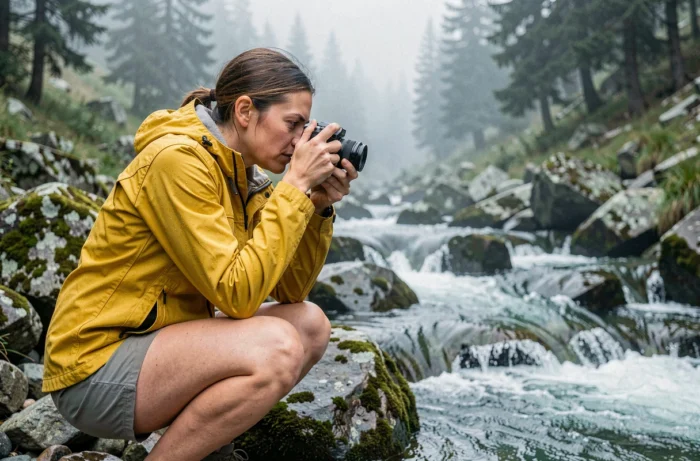
We are kayaking, it’s raining, and the case is sliding on the deck of the boat. Or we are hiking in a mountain storm with volcanic sand in our pockets. A classic compact camera won’t last two days in these conditions.
The market for waterproof and shockproof compact cameras has shrunk in recent years, in favor of action cams and rugged smartphones. Finding the right model requires understanding what separates a true adventure compact from a marketing gadget.
Waterproofing and shock resistance: what the standards don’t tell you
A compact camera advertised as waterproof specifies a maximum immersion depth. This figure corresponds to a laboratory test, in fresh water, without sudden movements. In real-life situations (jumping into water, currents, saltwater), the stress on the seals is much greater.
Shock resistance follows the same logic. An advertised drop height assumes a flat surface and a free fall without rotation. On an uneven rock, the impact concentrates on a specific point of the case, which can damage the optics or crack the battery compartment cover.
Before leaving, we systematically check two things: the condition of the O-rings and the closure of the battery flap. A grain of sand stuck in the seal is enough to cause an infiltration. Some manufacturers provide silicone grease to maintain these seals, a low-cost but necessary accessory in the field.
Choosing a waterproof and shockproof compact camera suitable for your outings means cross-referencing the advertised immersion depth with the type of activity actually practiced: snorkeling on the surface and diving several meters do not stress the case in the same way.
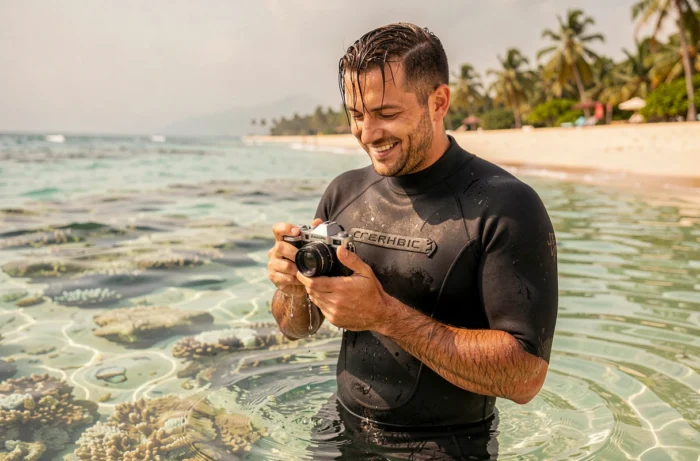
Sensor and optical zoom: balancing image quality against compactness
In this segment, almost all models feature a small sensor. The reason is mechanical: a larger sensor (like APS-C) would require a bulkier lens, incompatible with a sealed and compact case.
A small sensor limits the increase in ISO sensitivity. In full sunlight or underwater with natural light, the results are quite usable. However, as soon as the light decreases (dense forest, end of the day, murky water), digital noise increases quickly and image quality degrades.
The optical zoom is the other variable. A low-magnification zoom (around 4x) generally offers better optical quality than an extended zoom because the number of lenses remains limited in a sealed tube. Models that offer a longer zoom often do so at the cost of reduced brightness at the extremes.
Macro mode and underwater video
Several adventure compacts include a high-performing macro mode, sometimes capable of focusing just a few centimeters from the subject. To photograph underwater wildlife (anemones, nudibranchs, corals), the macro mode is often more useful than a large zoom.
On the video side, most recent models shoot in 4K. Electronic stabilization partially compensates for movements in the water, but it crops the image and reduces the field of view. We keep this in mind when filming while snorkeling.
Waterproof compact, action cam, or IP68 smartphone: which tool for which use
The segment of rugged compacts has significantly shrunk. A few references remain (the OM System TG range, the Ricoh/Pentax WG range), but competition now comes from elsewhere. Ricoh has also announced the discontinuation of the Pentax WG-90, with a new rugged model planned to replace this reference.
- The action cam (GoPro, DJI Osmo Action) excels in wide-angle video and can be mounted anywhere, but its tiny sensor and fixed focal length make it limited for varied photography (portraits, close-ups, details).
- The reinforced IP68 smartphone is always in your pocket and connected, but its fixed focal length optics and pressure resistance underwater are still inferior to those of a dedicated compact.
- The adventure compact offers a true optical zoom, a macro mode, an integrated flash, and ergonomics designed for use with wet or gloved hands. It’s the only one that combines photographic versatility with certified depth robustness.
For pure action video, the action cam remains more suitable. For versatile photography in hostile environments, the waterproof compact retains a clear advantage.

Points to check before buying an adventure compact
You don’t choose this type of case based solely on the technical specifications. A few field criteria make a difference once you are on-site.
- The size and relief of the buttons: with neoprene gloves or wet fingers, a flush button is unusable. The best models have protruding and knurled controls.
- The battery life in cold water: cold reduces the actual capacity of the battery. Carrying a spare battery in a waterproof bag is a simple precaution.
- Compatibility with an optional dive housing: some compacts come with a dedicated housing that extends the usable depth well beyond the native limit. A housing transforms a snorkeling compact into a diving tool.
- The weight with a floating strap: in the sea, a sinking camera is a lost camera. The provided or optional floating strap makes all the difference.
Feedback varies on the longevity of the seals after two or three seasons of intensive use in saltwater. Rinsing the case with fresh water after each marine outing and storing the camera with the flap open to ventilate the battery compartment remain the most effective maintenance gestures.
The market is tightening, but the few adventure compacts still available meet a need that no smartphone or action cam fully covers. A true optical zoom, a flash, a macro mode, and buttons usable underwater: it’s this combination that still justifies the purchase of a dedicated case.