In France, the population over 60 is growing at a pace that compels public authorities and private stakeholders to rethink support for aging. The regulatory framework is evolving, new financial mechanisms are emerging, and technologies are diversifying. Staying at home remains the primary wish of seniors, which places the adaptation of housing and digital tools at the center of decision-making.
MaPrimeAdapt’ and housing adaptation for seniors: what financing changes
Before discussing sensors or artificial intelligence, the first condition for autonomy remains the housing itself. A poorly lit staircase, a bathtub without grab bars, or a door threshold that is too high cause a considerable number of falls among the elderly each year.
The MaPrimeAdapt’ program, managed by Anah through France Rénov’, alters the financial scale of these renovations. It covers up to 70% of a defined work ceiling for individuals aged 60 to 70, depending on their situation and level of loss of autonomy. Secure bathrooms, replacing a bathtub with a walk-in shower, installing handrails, or motorizing shutters: the eligible items cover most of the necessary adaptations.
The question that arises concerns effective access to this aid. Processing times, the need to provide a housing diagnosis, and the mandatory use of approved craftsmen create friction. For isolated seniors or those unfamiliar with administrative procedures, the process remains complex. Platforms like seniorizon.fr help centralize information on these aids and available services, simplifying part of the research work.
Connected objects and teleassistance: promises to confront with real uses
Connected objects for seniors occupy an increasing place in discussions about autonomy. Fall detection bracelets, connected pill dispensers, motion sensors at home: the offerings have significantly expanded in recent years.
Teleassistance remains the most widespread device. An alert button worn as a pendant or on the wrist connects the person to a listening center available at all times. The principle works, but it assumes that the person actually wears the device and is able to press it. Field feedback varies on this point: a significant portion of beneficiaries eventually stop wearing the pendant, either due to forgetfulness or embarrassment.
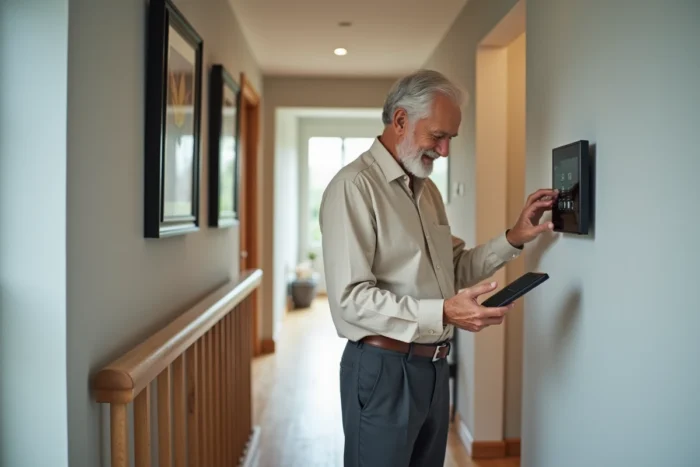
Next-generation sensors attempt to solve this problem by automatically detecting falls or anomalies in movement within the home, without user intervention. This approach raises questions about the management of health data collected at home, its storage, and its sharing with caregivers or healthcare professionals.
What connected objects concretely cover
- Monitoring physical activity (pedometers, smartwatches) allows caregivers to detect a decline in mobility before it becomes critical.
- Connected pill dispensers send an alert in case of missed medication, a direct issue for individuals on chronic treatment.
- Connected nutrition devices (glasses, water bottles) measure daily hydration, a often overlooked indicator among elderly people living alone.
The available data do not allow for conclusions about the overall impact of these objects on reducing hospitalizations. Their effectiveness largely depends on the human ecosystem surrounding them: a sensor without a trained caregiver to interpret alerts loses much of its utility.
Digital support for seniors: mediators and Digital Pass
Autonomy is not limited to physical housing. The digital divide isolates seniors from services that have become mandatory online: tax declarations, making medical appointments on Ameli, renewing vehicle registration. Without support, these procedures become a factor of dependency on those around them.
Since 2023, the state has structured support through digital mediators present in libraries, France Services spaces, and PIMMS. These mediators carry out online procedures for free with the individuals concerned and offer personalized support.
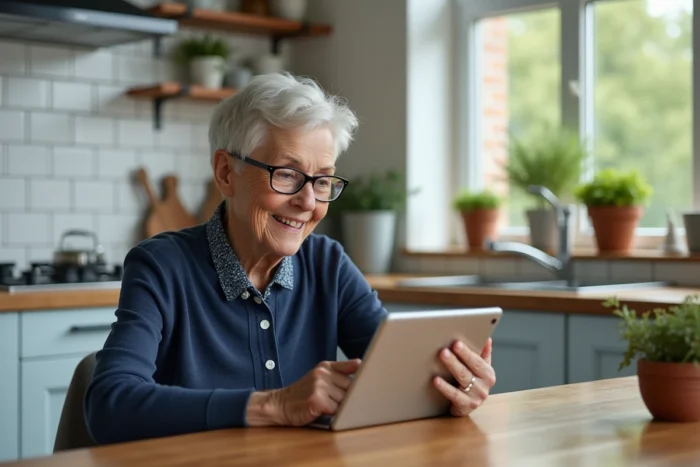
At the same time, introductory workshops on digital technology specifically target seniors: handling a tablet, sending emails, video conferencing with family. Funding is provided in part through the Digital Pass, a checkbook (5 or 10 checks of 10 euros each) that grants free access to local training.
Limits of the digital inclusion system
The territorial network remains uneven. Rural areas, where the proportion of seniors is often higher, have fewer France Services access points than urban areas. Occasional training is not always sufficient: without regular practice, skills acquired in workshops erode within weeks.
The shift to digital for public services continues to accelerate. The challenge goes beyond technical training: it is also about maintaining non-digital alternatives for those who cannot or do not wish to use these tools.
Senior residences and alternatives to individual housing
When staying at home reaches its limits, senior residences represent an intermediate option between traditional housing and medicalized facilities. These structures offer individual apartments with shared services: dining, activities, and the presence of coordinating staff.
The model differs from nursing homes by the absence of heavy medicalization. Residents retain their freedom of movement and manage their daily lives while benefiting from a secure environment. Other formats are emerging, such as shared housing or intergenerational co-living, which aim to address social isolation while reducing costs.
Price remains a determining selection criterion. Private senior residences have rates that exclude a significant portion of the elderly population. Associative or public options exist, but their availability varies greatly by region.
Improving the daily lives of seniors relies on a combination of solutions, not on a miracle technology. Adapting housing, structuring digital support, deploying connected objects within a coherent human framework, and diversifying housing forms are all levers. Their real effectiveness depends on the ability to articulate these levers around the concrete needs of each person, rather than a catalog logic.