Building an elegant wardrobe for everyday life involves balancing pieces that easily combine with cuts that withstand weekly rotations. The question deserves to be asked from an angle rarely addressed by classic fashion guides: how many distinct outfits can one actually compose with a limited number of garments, and what criteria separate a worthwhile piece from an impulsive purchase that ends up forgotten on a hanger?
Cost per wear: the true indicator of a trendy, cost-effective wardrobe
Lists of essential basics abound, but they rarely compare the relationship between the purchase price and the number of times a piece is actually worn. This ratio, called cost per wear, changes the way we view a fashion budget.
| Item | Estimated frequency of wear (per year) | Average lifespan | Number of possible outfits |
|---|---|---|---|
| Straight or semi-slim jeans | High (several times a week) | Several years with good denim | Compatible with almost any top |
| White cotton shirt | High | Long if the weave is dense | Worn open, closed, knotted, under a jacket |
| Structured jacket (blazer or overshirt) | Moderate to high | Long | Pairs well with jeans, dress pants, a dress |
| Solid straight dress | Moderate | Long if the fabric doesn’t pill | Worn alone, belted, layered with a turtleneck |
| Trendy seasonal piece | Low (a few weeks) | Short (dated cut or pattern) | Often limited to one or two looks |
The last line of the table illustrates the trap: a very trendy piece bought at a low price but worn five times ends up costing more per use than a classic black pant worn a hundred times. The cost per wear favors neutral, well-cut pieces, not the lowest price tags.
To explore selections that apply this logic of durable and combinable pieces, a useful resource: https://www.modenmarie.com/.
Fabrics and cuts: what separates a reliable basic from a disposable garment
The debate on the capsule wardrobe often focuses on the number of pieces. It overlooks a more determining factor: the fabric density and seam finishing. A white t-shirt in fine jersey distorts after a few washes. The same t-shirt in a heavier cotton retains its shape for several seasons.
Selection criteria by type of piece
- For jeans or pants: check the stiffness of the denim or twill before purchase, prefer a size that doesn’t require a belt to hold up, and choose a straight or slightly fitted cut that withstands trend variations.
- For a shirt: a poplin cotton or blended linen offers a crisp drape without excessive ironing. English seams (edges folded inside) indicate a durable finish.
- For a structured jacket: the inner lining, even partial, maintains the shoulder shape over time. An unlined blazer distorts faster, especially when worn daily.
The French regulatory context reinforces this logic of quality. The law against ultra-fast fashion provides for financial penalties adjusted according to a sustainability coefficient, integrated into environmental labeling. This coefficient takes into account the traceability of manufacturing steps and the encouragement to repair. Pieces from brands with very high turnover will also be subject to the ban on advertising for ultra-fast fashion products.
In practice, garments with very rapid turnover will lose advertising visibility and become more expensive to produce. Choosing a durable piece is no longer just aesthetic; it becomes a rational economic calculation.
Color palette and combinations: black, white, and neutrals as a foundation
Search data confirms it: the terms black, white, and basics consistently appear in queries related to the everyday wardrobe. This is no coincidence. A narrowed palette around three to four neutrals multiplies possible combinations without increasing the number of pieces.
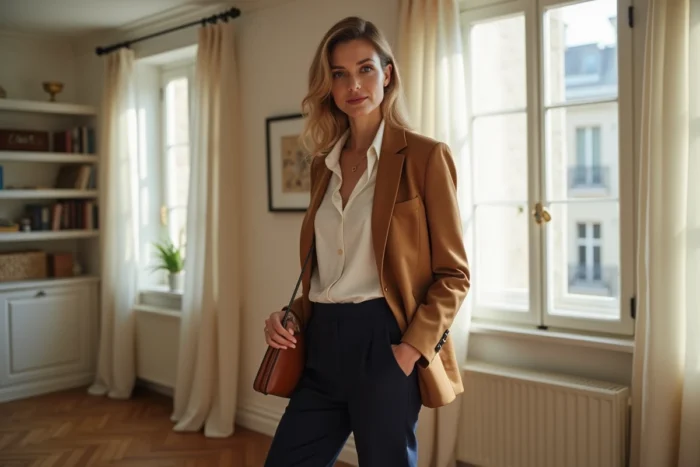
A core made up of raw jeans, black pants, a white shirt, and a beige or navy jacket already generates several distinct looks depending on the combinations. Adding a single piece in a bright color or a print to this foundation allows for contrast without destabilizing the whole.
The common mistake: accumulating neutrals without texture variation
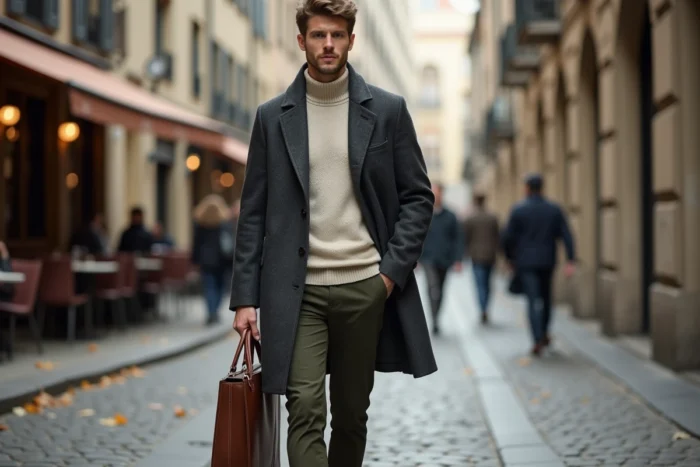
Wearing black from head to toe works, provided you vary the materials. Fine wool pants, a ribbed knit turtleneck, and a wool coat create visual relief even in a strict monochrome. In contrast, combining several black jersey pieces gives a uniform and flat effect.

The relaxed chic trend dominating style proposals in 2026 is precisely based on this play of textures within a sober palette. Fluid silhouettes (wide pants, oversized shirt, deconstructed jacket) draw their elegance from the contrast between a matte fabric and a slightly shiny fabric, or between a thick knit and a fine cotton.
Weekly rotation: organizing outfits by blocks rather than by piece
Thinking in complete outfits rather than isolated garments reduces the time spent each morning in front of the wardrobe. The principle: prepare three to four blocks of outfits for the week, each built around a different bottom.
- Jean block: straight jeans + white shirt on Monday, straight jeans + t-shirt and blazer on Thursday. Same bottom, two distinct looks.
- Dress pants block: black pants + fine sweater on Tuesday, black pants + oversized shirt on Friday.
- Dress block: straight dress worn alone on Wednesday, reused over the weekend with a turtleneck underneath and a belt.
Three bottoms and five tops are enough to cover a complete week without visible repetition. Accessories (belt, scarf, discreet jewelry) change the perception of an outfit without adding a piece to the closet.
This block approach works even better when the pieces share the same color palette. A top intended for the jean block should also work with the dress pants. It is this interchangeability that distinguishes a thoughtfully designed wardrobe from an accumulation of separately purchased garments.
The most reliable criterion for evaluating your wardrobe remains the number of actual combinations, not the number of pieces. A closet of twenty well-chosen garments surpasses a wardrobe of fifty items, half of which can only be worn with a single outfit.