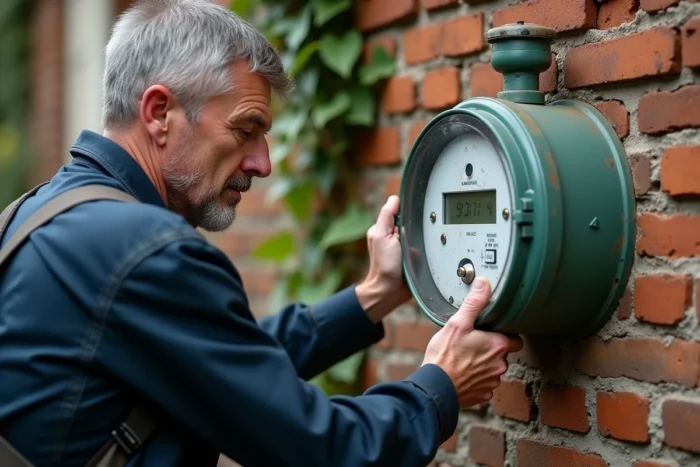
When you read your gas meter, the display shows cubic meters. The bill, however, presents kilowatt-hours. Between the two, a coefficient transforms a volume into energy, and this coefficient varies depending on where you live, the time of year, and the type of gas supplied. Understanding this mechanism allows you to verify your bill and anticipate your energy budget.
Pressure and altitude: two variables that change the result on your gas bill
Most guides on the m3/kWh conversion simply explain the formula. In practice, it is observed that the coefficient applied to two households located in different municipalities can generate a notable discrepancy on the bill, even for the same volume consumed.
The delivery pressure plays a direct role. Gas delivered at low pressure (domestic network) does not have the same energy density as that supplied at medium pressure for professional use. The network manager corrects this difference in the calculation of the coefficient.
The altitude of the municipality also comes into play. The higher the altitude, the lower the atmospheric pressure, which reduces the amount of energy contained in a cubic meter of gas. A municipality in the mountains will have a slightly lower coefficient applied than that of a coastal city. To better understand the conversion of gas m3 to kWh, it is important to keep in mind that these adjustments are not trivial: they reflect measurable physical realities.
In summary, two households consuming the same volume of gas do not necessarily pay the same amount of kWh. The coefficient incorporates these corrections so that the billing corresponds to the energy actually available, not just the volume transited.

Gas conversion coefficient: the formula and what makes it vary
The formula is simple on paper: kWh = m3 consumed x conversion coefficient. The coefficient represents the higher calorific value (HCV) of natural gas, which is the amount of energy released by the combustion of a cubic meter under reference conditions.
Three factors influence this coefficient:
- The composition of the supplied gas, which depends on its geographical origin and treatment. Rich gas (type H) has a higher HCV than poor gas (type B), distributed in certain border areas in northern France and Belgium.
- The altitude of the consumption municipality, which modifies the atmospheric pressure and thus the density of the gas at the meter.
- The effective delivery pressure in the local network, adjusted by the distribution network manager.
In France, GRDF recalculates these coefficients each month for each distribution area. The average coefficient for gas H is around 11.2 kWh/m3, while that for gas B is lower, around 10 kWh/m3.
Rich gas and poor gas: a distinction that affects the bill
Gas H (high calorific value) covers the vast majority of French territory. Gas B (low calorific value), historically imported from the Netherlands, mainly serves Hauts-de-France and a few border municipalities in Belgium.
The difference between the two is directly reflected in the conversion coefficient. For the same volume at the meter, gas B produces less energy than gas H, which implies a lower coefficient. Feedback on this point varies by municipality, as the gradual transition from gas B to gas H modifies the coefficients applied locally.
Check the conversion coefficient on your gas bill
On a natural gas bill, the conversion coefficient appears in the section detailing the calculation of consumption. It usually includes three lines: the starting index, the ending index (which give the volume in m3), and then the multiplication coefficient used to obtain the billed kWh.
To verify this figure, you can compare it with the value published by the network manager of your municipality. In France, GRDF provides the coefficients by area. In Belgium, the data published by CREG show significant variations depending on the distribution network manager (GRD).
According to the 2025 data available for Belgium:
- In Wallonia (ORES, Resa), the average coefficients vary between 10.81 and 12.79 kWh/m3.
- In Flanders (Fluvius), the range goes from 9.53 to 12.79 kWh/m3.
- In Brussels (Sibelga), the coefficient is around 11.55 kWh/m3.
Checking your coefficient allows you to detect a billing anomaly. If the coefficient displayed on the bill deviates significantly from the value communicated by the GRD for the same period, you should contact your supplier.
Conversion m3 to kWh for propane: a different calculation
Natural gas is not the only one affected by this conversion. Users of propane tanks also encounter the issue, but with very different values.
Propane has a significantly higher higher calorific value than natural gas. One cubic meter of gaseous propane contains about twice as much energy as one cubic meter of natural gas. Confusion is common among individuals transitioning from a natural gas network to a propane installation, or vice versa.
For propane, the conversion is often done based on weight (kg) rather than volume, as delivery in tanks is measured in liters or tons. The volumetric coefficient therefore does not have the same operational utility as for network gas.
Gas kWh price: why the m3/kWh conversion affects your energy budget
Knowing your consumption in kWh (and not just in m3) allows you to compare supplier offers on a common basis. All gas rates are expressed in euros per kWh. Without reliable conversion, you compare volumes to unit energy prices, which skews any estimation.
The price of natural gas kWh has seen marked fluctuations in recent years in Europe. Monitoring your consumption converted to kWh, month by month, remains the most reliable way to identify a consumption drift or a previously unnoticed price change.
A monthly meter reading cross-referenced with the conversion coefficient provides a reliable estimate of your upcoming bill. This is a simple reflex that avoids unpleasant surprises at the annual settlement, whether connected to gas H, gas B, or a propane installation.