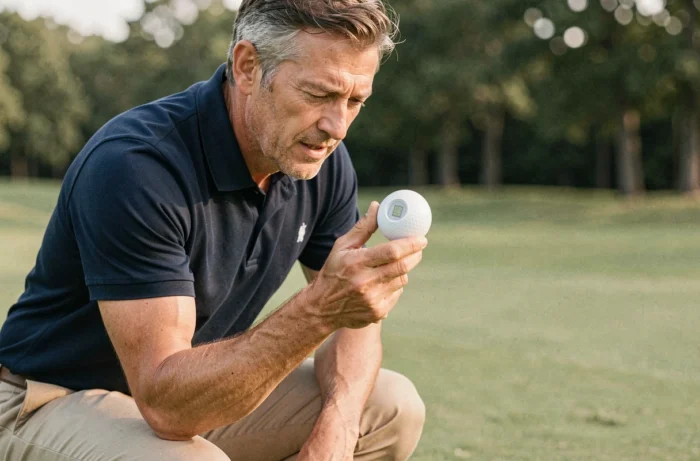
Locating a lost golf ball in thick rough or behind a bush remains one of the most common irritants on a course. The GPS-enabled golf ball offers a technical solution to this problem by integrating a miniaturized transmitter directly into the ball. The concept seems simple, but its implementation raises questions of regulation, cost, and reliability that deserve careful examination.
Physical constraints of a chip integrated into a golf ball
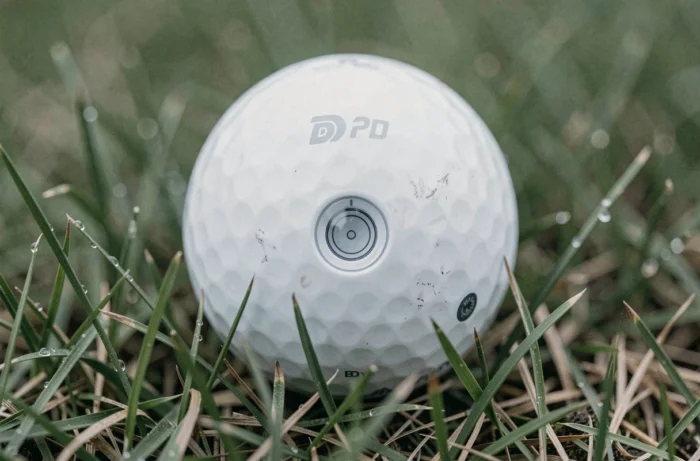
The idea of inserting an electronic component into a golf ball faces extreme conditions. During a drive, the ball experiences considerable accelerations and impact forces. Ensuring the survival of a printed circuit, an antenna, and a power source under these conditions requires years of research in encapsulation and plastics.
The mass and balance of the ball present a second challenge. Manufacturing rules impose very tight tolerances on weight, diameter, and symmetry. Any asymmetry caused by an internal component alters the trajectory, rendering the ball unusable for serious play. Current prototypes attempt to solve this issue with ultra-light chips positioned at the exact geometric center.
The concept of GPS-enabled golf balls thus relies on a constant compromise between the miniaturization of the electronic module and adherence to the mechanical characteristics that ensure a ball flies correctly.
Rule 4.3 of the USGA and R&A: what the regulations really allow
Since the modernization of the rules in 2019, distance measuring devices (GPS, rangefinders, apps) are allowed by default in part. The boundary drawn by rule 4.3 is clear: equipment can inform the player (distance, direction, weather conditions), but it cannot make judgments on behalf of the player based on the current position of their ball.
In practical terms, a GPS ball that simply emits its position for the player to find in the tall grass remains within the allowed framework. However, if the system associated with this ball provides real-time club recommendations or a calculated line of play based on the location, it falls under the prohibition.
Competition committees have an additional lever: the local rule model G-5 allows them to outright ban any distance measuring device. Some high-level circuits continue to enforce this restriction. A GPS ball is therefore limited to recreational play and practice as soon as it exceeds the simple function of localization.
A gray area between localization and assistance
The regulatory text does not explicitly mention connected balls, which did not exist in commercial form at the time of writing. Field feedback varies: some committees consider that finding one’s ball using a GPS signal already constitutes assistance in play.
Others believe it is simply equivalent to asking a spectator to point out the area of the drop. As long as the USGA and R&A have not published a specific ruling, uncertainty will persist for local amateur competitions.
Integrated GPS or external tracking accessories: which system locates better
The market currently offers two distinct approaches for locating balls or analyzing shots. Comparing them helps to understand why the GPS ball struggles to gain traction.
- Golf GPS watches and devices (like Garmin, Arccos) use sensors attached to the club grip and a smartphone app. They calculate the distance covered by each shot, map the course, and provide detailed statistics without altering the ball itself.
- The integrated GPS ball promises to combine everything into a single object, without external sensors or cameras. However, its theoretical advantage (no accessories to carry) is countered by a limited lifespan of the internal battery and a significantly higher cost per ball compared to a standard ball.
GPS balls are currently positioned as a niche product, more expensive and less cost-effective than external alternatives. A GPS watch purchased once accompanies the player for several seasons. A connected ball lost in a pond, on the other hand, takes its module with it.
Connected ball and game data: what digital golf really produces
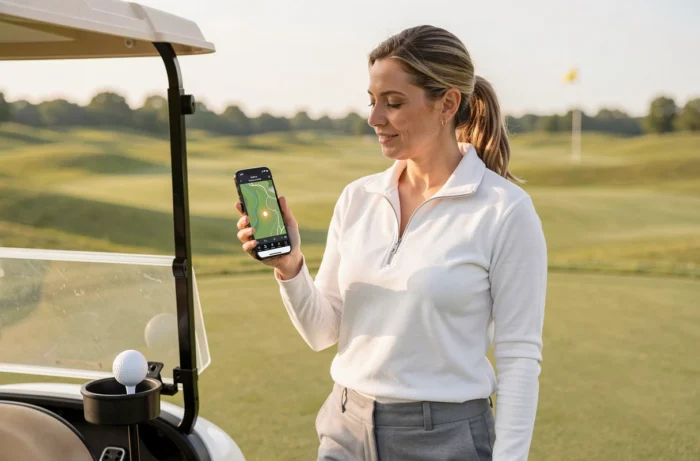
Beyond localization, the commercial argument for connected balls relies on the promise of data. Launch speed, spin, attack angle: the same metrics as a high-end launch monitor, directly from the ball.
Some approaches favor a passive ball rather than an embedded GPS transmitter. Instead of equipping the ball with an active module, internal markers enhance data capture by existing launch radars, especially in indoor environments. The ball remains passive; it is the external radar that does the work.
This distinction matters: a passive ball unambiguously complies with competition rules. It measures nothing, emits nothing, stores nothing. The player benefits from more reliable data in a simulator without compromising the compliance of their ball on the course.
The question of lifespan and cost per round
A standard golf ball costs between a few cents and a few euros depending on the range. A ball incorporating an active GPS module significantly multiplies this price. If the battery lasts for several rounds before depleting, the cost per round remains much higher than that of an external tracker amortized over several years.
The loss of balls complicates the equation. An amateur player loses on average several balls per round. Each lost ball represents the simultaneous loss of a consumable and an electronic component, a business model difficult to defend against wrist-worn or bag-mounted solutions.
The GPS-enabled golf ball embodies an appealing technical convergence between a sports object and a connected object. The regulatory, physical, and economic obstacles that hinder its adoption are not minor. As long as the cost per ball does not decrease and governing bodies do not clarify their position for competitions, this innovation will remain a tool for training and leisure rather than a standard for play.