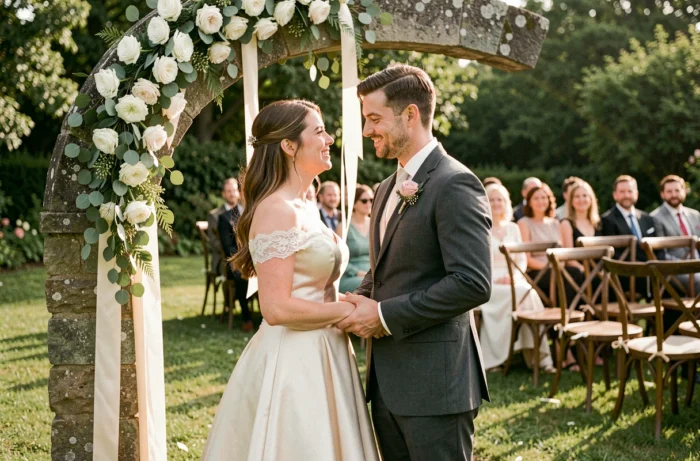
A couple who books a venue with accommodation for the weekend is no longer managing a wedding, but a celebration stay. Between the staggered arrivals of guests on Friday evening, the Sunday brunch, and the ceremony itself, expenses multiply, and the financial pressure affects both the couple and their loved ones. Organizing an elegant wedding today means first accepting this reality before choosing any decoration.
Multi-day wedding: the logistics that no one budgets for
The weekend format is gradually becoming the norm. Welcome dinner on Friday, ceremony and reception on Saturday, brunch the next day on Sunday. On paper, the idea is appealing: it transforms the day into an immersive experience for guests. In practice, each added highlight generates a distinct budget line.
The first instinct is to look for a reception venue that offers on-site accommodation. But renting a venue with cottages is significantly more expensive than a dry hire. You pay for the site privatization, the availability of rooms, sometimes cleaning and linens. Before signing, it’s essential to list what is included and what falls under additional services.
To structure the preparations without losing sight of the actual budget, one can rely on wedding advice on Mariage et Décoration that details the concrete steps of organization.
The next day’s brunch is another common pitfall. Feedback varies on this point: some venues include it in the package, while others charge an extra fee per guest. If you plan a brunch for half of your guests, add this line to the budget from the start, not three months before the date.

Elegant wedding budget: making choices without sacrificing ambiance
The financial tension surrounding the wedding does not only concern the couple. A significant portion of guests decline invitations or go into debt to attend, considering the gift, transportation, accommodation, and attire. An elegant wedding also takes into account the guests’ wallets.
Specifically, one can act on three levers without affecting the atmosphere of the day:
- Reduce the guest list to enhance the quality of each item (meals, decoration, drinks) rather than diluting the budget over a large number of guests.
- Choose an off-peak date, a Friday or a Sunday, which lowers the venue and most suppliers’ rates.
- Focus spending on two or three high-impact visual elements (flowers, lighting, table) and simplify the rest, rather than spreading it thin everywhere.
The classic mistake is wanting to check all the boxes of the “perfect” wedding seen on social media. A photobooth, a cocktail bar, fireworks, a live band, a DJ: the sum of these activities can blow the budget. Two well-chosen activities leave a stronger impression on guests than a succession of mediocre offerings.
Wedding decoration: elegance through simplicity
The trend towards understated elegance is gaining ground. We’re talking about tight palettes (two or three colors maximum), raw materials (linen, wood, ceramics), and less voluminous but better-crafted floral arrangements.
This aesthetic choice has a direct financial advantage. Fewer varieties of flowers to order, fewer small decorative items to buy, less setup time. Simplicity is not a compromise; it’s a style choice that simplifies logistics on the big day.

Civil or religious ceremony: what the format changes in organization
The choice between a civil ceremony and a religious ceremony is not only a matter of personal conviction. It has direct consequences on the day’s schedule, the number of venues to book, and the budget.
A civil ceremony organized at the reception venue eliminates one trip. Guests arrive once, settle in, and the day unfolds without logistical transitions. You save travel time, vehicle coordination, and often the rental of a second space.
Conversely, a trip to the town hall followed by a religious ceremony and then a reception at a third location creates three distinct highlights. It’s more traditional, but it requires a tight schedule and a transportation system for guests who do not have a vehicle.
Personalizing the ceremony without overloading the program
Civil ceremonies allow total freedom over the content: readings, live music, symbolic rituals. The trap is to do too much. A forty-five-minute ceremony with eight speakers exhausts guests’ attention.
It’s recommended to have a maximum of three to four interventions, a clear thread, and a duration that does not exceed thirty minutes. Couples who want to involve their loved ones can distribute roles between the ceremony and other moments of the day (speeches during the meal, entertainment during the cocktail hour).
Guest list and seating plan: two decisions that condition everything else
The guest list determines the venue, the caterer, the number of tables, the size of the cake, the quantity of drinks. Each additional person has a unit cost that impacts all budget lines. Setting this list early in the preparations avoids having to renegotiate everything along the way.
The seating plan remains the most underestimated puzzle of the organization. It’s often thought about in the last weeks, while it directly influences the meal’s ambiance. Grouping guests by affinities rather than family obligation creates livelier tables.
- Plan a “mixed” table for guests who don’t know anyone, with sociable personalities identified in advance.
- Avoid tables of more than ten people, which hinder group conversation.
- Send confirmations of attendance at least six weeks before the date to stabilize the plan.
The wedding that remains memorable is not the one with the biggest budget or the most spectacular decoration. It’s the one where guests had a smooth evening, where the ceremony was sincere, and where the couple appeared relaxed. This result is built through the choices made in advance, not through the accumulation of services on the big day.